Product Overview
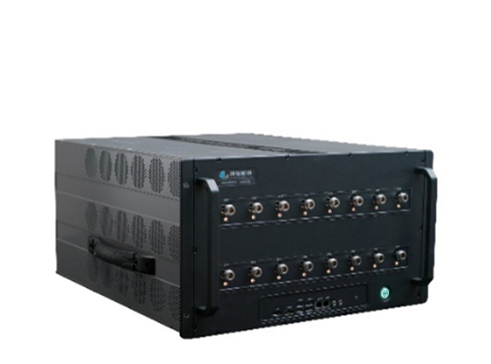
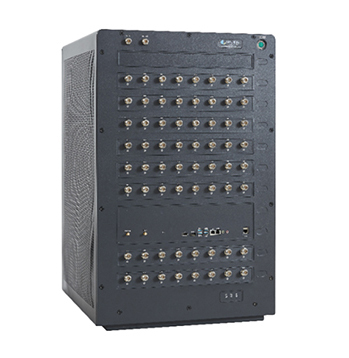
KSW-WNS02B Wireless Channel Emulator (also known as 'wireless channel simulator' and 'RF channel emulator') is a kind of simulation equipment used in wireless channel environment, to realize RF channel interconnection and simulation of dynamic wireless channel. According to different testing requirements, KSW-WNS02B has the following functions:
1) Complex topology networking of multipoint-to-multipoint RF channels;
2) Wireless channel simulation: Simulation of multipath effect, Doppler frequency shift, fading channel impulse response, dynamic delay, interference signal superposition, signal-to-noise ratio, etc.
8/16-CHANNEL WIRELESS CHANNEL EMULATOR
64-CHANNEL WIRELESS CHANNEL EMULATOR
Key Features
Key Parameters
| KSW-WNS02B Mesh Channel Emulator | ||
| Item | Name | Parameters |
| 1 | RF channel | 64 channels optional, full duplex (transmitter/receiver integrated or separated) |
| 2 | Frequency range | 1.5MHz~6GHz or 30MHz~6GHz |
| Frequency extension option: Up to 40GHz | ||
| 3 | Number of local oscillators | Each RF port has a receiver local oscillator and a transmitter local oscillator, supporting up to 128 local oscillators |
| 4 | Channel bandwidth | 2MHz、40MHz、100MHz、120MHz、500MHz、600MHz |
| 5 | Carrier aggregate bandwidth (optional) | Up to 2GHz |
| 6 | Number of fading channels | Maximum 2048 |
| 7 | Frequency Accuracy |
10-7 |
| 8 | Input signal power range |
-40dBm~30dBm |
| 9 | Output signal power range | -120dBm~ 0dBm |
| 10 |
Output signal power resolution |
0.1dB (output signal power ≥-100dBm) |
| 11 |
Output signal power accuracy |
± 1dB (output signal power ≥ -100dBm) |
| 12 |
Delay range |
4.5us~1.6s@1MHz/40MHz/120MHz/500MHz/600MHz |
|
4.5us~3s@500MHz |
||
| 13 |
Delay emulation resolution |
0.1ns |
| 14 | Maximum Doppler frequency shift | ±6MHz |
| 15 | Code Doppler (option) |
Maximum support speed 30 Mach |
| 16 | Doppler frequency shift precision | ±0.1Hz |
| 17 | Coded Doppler (optional) | Support maximum bandwidth of 500MHz, maximum speed of 30Mach, and precision of 1Hz |
| 18 | Output signal non-harmonic spurious distortion | ≤ -45dBc |
| 19 | EVM | ≤1%@256QAM,100MHz modulation signal, 2GHz frequency point |
|
≤1.5%@256QAM,100MHz modulation signal,24GHz frequency point |
||
| 20 | Background noise | Not higher than -162dBm/Hz@output signal power≤-40dBm |
| 21 | Channel isolation | 135dB@F≤6GHz (Typical) |
|
110dB@F≤18GHz(Typical) |
||
|
100dB@F≤40GHz(Typical) |
||
| 22 | I/O port standing-wave ratio | 1.6@F≤6GHz |
|
1.8@F≤18GHz |
||
|
2.0@F≤40GHz |
||
| 23 | Fading channel model | Constant, Rayleigh, Rice, Nakagami, flat, domed, Gaussian, double Gaussian, LOGNORMAL, Suzuki, pure Doppler, Butterworth, custom mode, etc. |
| 24 | Standard channel model |
COST207、GSM/EDGE、ITU_R 3G、JTC、HIPERLAN/2、3GPP LTE、ITU1546、ITU2001、ITU526、ITU530、ITU617、ITU618、 ITU676、ITU679、ITU680、ITU681、ITU682, etc. |
| 25 | DMT Dynamic Modeling Software (Option) |
Support 3D spatial AD hoc networking and satellite orbit modeling, support TLE, STK, WI, ASC and other file conversion, support antenna pattern import, support phased array direction finding function, support 3D spatial model file generation after the one-click import channel emulator |
| 26 | AWGN/CW interference source emulation |
Supported |
| 27 | Other interferences (optional) | Comb interference, frequency hopping interference, frequency sweeping interference, pulse interference, and uniformly distributed interference |
| 28 | Continuous phase change | Supported |
| 29 | Automatic calibration function | Supported |
| 30 | Dynamic delay update rate | Maximum 2us/ms, with corresponding speed of 600km/s |
| 31 | External reference input interface | 10MHz |
| 32 | Internal reference output interface | 10MHz |
| 33 | Emulation synchronization trigger interface | Supported |
| 34 | External control interface | 1000M Ethernet |
| 35 | Remote control interface | Supported |
| 36 | Emulation of spacecraft load characteristics (600MHz option) |
Customizable group delay and amplitude-frequency jitter emulation in the 600MHz instantaneous band Emulation of IMUX/OMUX multiplexer characteristics for spacecraft loads Nonlinear characteristics of TWTA amplifiers for spacecraft loads Phase noise emulation of spacecraft load cross-frequency retransmission mixer |
| 37 | Dimension (W x D x H) (mm) | 8/16 channels: 485×277×602 (rack-mounted) |
|
24/32/40/48/56/64 channels: 520×590×880 |

||
| KSW-WNS02B MIMO Wireless Channel Emulator | ||
| Item | Name | Parameters |
| 1 | RF channel |
RF device 1: Support a maximum of 64 transceiver N (f) ports, two-way and one-way communication RF device 2: Support a maximum of 64 receiver + 64 transmitter SMA (f) ports, or 64 transceiver SMA (f) ports In terms of the number of connections, the maximum number is 64 input ports and 64 output ports. TDD and FDD communications are supported |
| 2 | Frequency range | 350MHz ~ 6GHz |
| MMW frequency extension option: 350MHz ~ 40GHz | ||
| 3 | Number of local oscillators |
Each RF port has independent transmitter and receiver local oscillators, i.e., an 8-port device can provide 16 local oscillators, and a 64-port device can provide 128 local oscillators
|
| 4 | Channel bandwidth (optional) | 100MHz/200MHz/400MHz/600MHz |
| 5 | Carrier aggregate bandwidth (optional) | Up to 1.6GHz |
| 6 | Number of fading channels |
The maximum configuration of the device, that is, the total number of fading channels at 100MHz bandwidth, is
32*16*24*2=24576 |
| 7 | MIMO networking scale |
100M firmware: Support up to 32*16 or 56*8 networking;
200M firmware: Support up to 32*8 or 16*16 networking; 400M firmware: Support up to 16*8 networking |
| 8 | Maximum number of multipaths for single fading channel | Supports user-configurable multipath parameters, with a maximum of 48 multipaths supported per channel. |
| 9 | Delay emulation range |
4.5us~45us Large delay option: Not less than 100ms |
| 10 | Multipath delay resolution |
7.6ns@100MHz
3.8ns@200MHz
1.9ns@400MHz
|
| 11 | Maximum movement speed | 1200km/h |
| 12 | Input signal power range | -40dBm ~ +30dBm |
| 13 | Output signal power range | -120dBm ~ 0dBm |
| 14 | Output signal power resolution | 0.1dB (output signal power ≥-100dBm) |
| 15 | Output signal power accuracy | ± 1dB (output signal power ≥ -100dBm) |
| 16 | Output signal non-harmonic spurious distortion | ≤-50dBc |
| 17 | EVM | ≤1%@256QAM, 100MHz modulation signal |
| 18 | Background noise | No more than -162dBm/Hz |
| 19 | Channel isolation | ≥ 135dB |
| 20 | I/O port standing-wave ratio | ≤1.6 |
| 21 | MIMO modelling software GSCM |
3GPP 36.104、3GPP 38.901、3GPP 36.827,WLAN 802.11n/ac/ax etc. Supports testing of terrestrial wireless communication base stations and terminal devices. |
| 22 | AWGN/CW interference source emulation | Supported |
| 23 | Automatic calibration function | Supported |
| 24 | Custom dynamic emulation | Supported |
| 25 | External reference input interface | 10MHz~100MHz |
| 26 | Internal reference output interface | 10MHz |
| 27 | Emulation synchronization trigger interface | Support trigger input and output |
| 28 | External control interface | 1000M Ethernet |
| 29 | Remote control interface | Supported |
| 30 | Dimension (W x D x H) (mm) | 8/16 channels: 485×602×277 (rack-mounted) |
| 24/32/48/56/64 channels: 520×590×880 | ||
| Configuration of WNS02B MIMO Wireless Channel Emulator | |
| Configuration Item | Description |
| RF device 1/2 | Hardware channel of wireless channel emulator, maximum 64 |
| Frequency converter | HF extension channel of channel emulator, maximum 40GHz |
| 100M firmware | Support maximum bandwidth of 100MHz |
| 200M firmware | Support maximum bandwidth of 200MHz |
| 400M firmware | Support maximum bandwidth of 400MHz |
| Carrier aggregate option | Support maximum bandwidth of 1.6GHz |
| Large delay emulation option | Support maximum delay of 100ms |